Roseau
Dominica
Roseau Beyond the Waterfront
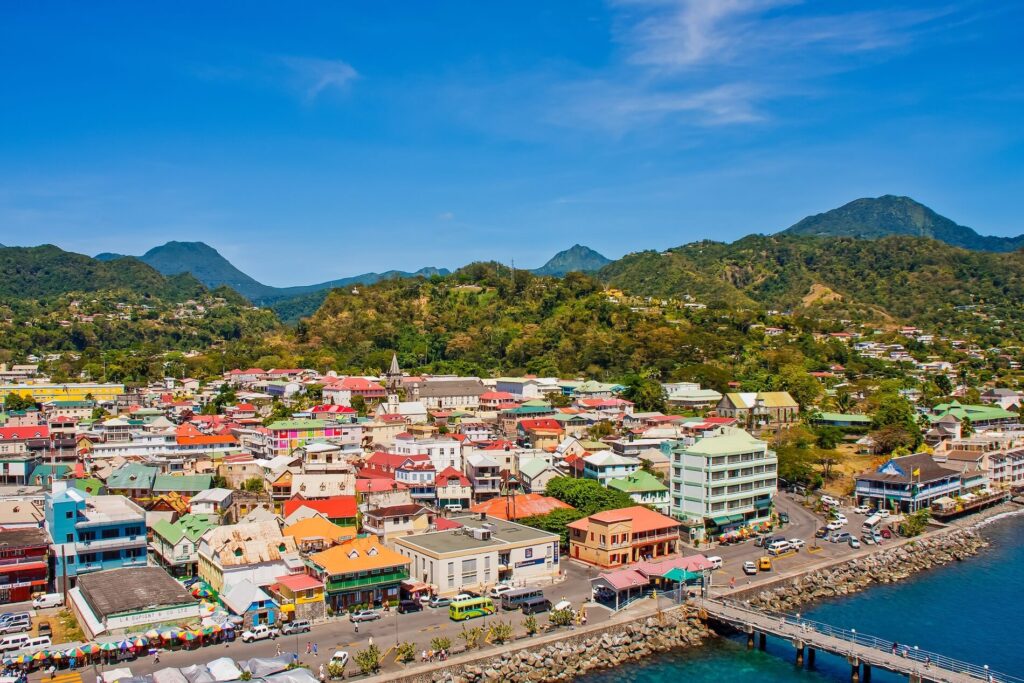
Roseau is small, colourful, busy and a little rough around the edges. It is not the kind of Caribbean capital that feels polished for visitors — except perhaps around the waterfront, where the city briefly becomes more arranged for cruise arrivals.
Beyond that first layer, Roseau feels much more local. You find pastel facades, wooden balconies, market stalls, traffic, churches, government buildings, side streets and mountain views in the background. The city sits between the Caribbean Sea and the hills, which gives it a compact but scenic setting.
That is also the best way to approach Roseau: not as a perfect sightseeing city, but as Dominica’s working capital with history, architecture, Carnival culture and everyday life all close together. You do not need several days to understand the basic layout. The waterfront, Old Market, Dominica Museum, cathedral, botanic gardens and central streets are all relatively close together. But Roseau is still worth taking your time with, especially if you are interested in architecture and history.
Its charm is in the details.
I understood Roseau best during Mas Domnik, Dominica’s Carnival. Not because I walked through it once with a map, but because we circled the city again and again on the road. During Carnival, Roseau becomes the route, the meeting point and the centre of the week. You pass the same corners several times. You start to recognize faces. People who were strangers on Monday feel familiar by Tuesday.

Best places to stay in Roseau
Roseau is not a place where I would look for a sealed-off resort. If you stay in or near the capital, the value is access: the waterfront, markets, old streets, Carnival routes, ferry connections, dive trips and easy day trips into the Roseau Valley. I would choose somewhere that keeps you connected to Dominica’s local rhythm rather than hiding the city away.
Take a Historic Walking Tour
One of the best ways to understand Roseau is to take a guided historic walking tour.
At first glance, the city may look like a small Caribbean capital with colourful buildings and busy streets. But once a guide starts pointing out the details, you notice much more. A balcony is not just decorative. A courtyard is not just hidden behind an old townhouse. A market square is not just a place to pass through.
Roseau has a strong collection of traditional Caribbean architecture. A walking tour can help you notice old Creole townhouses, wooden fretwork balconies, timber details, historic courtyards and buildings shaped by climate, colonial history and Caribbean craftsmanship.
The balconies are especially important.
Many of Roseau’s older buildings have wooden fretwork balconies that are decorative but also practical. They provide shade, airflow and a connection between the private home and the public street. During Mas Domnik, they become part of the Carnival scene, with people watching from above, waving, laughing and commenting as the parade moves below.
A good walking tour can also explain the more difficult parts of Roseau’s history. The Old Market, for example, is connected to enslavement, trade and resistance. Some tours include stories such as the trial of Maroon chief Balla, old Creole townhouses, hidden courtyards and the Newtown Armoury, where you may learn about the liberation of 433 people from an illegal slave-trading ship.
This kind of context makes Roseau much more interesting. Without a guide, you may mostly notice colour and charm. With a guide, you begin to understand the architecture, the social history and the stories behind the streets.
For culturally curious travelers, I would not skip this. Roseau is small enough to walk, but layered enough to benefit from interpretation.
The Waterfront: Roseau’s Most Polished First Impression
For many travelers, Roseau begins at the waterfront.
This is where cruise passengers arrive, taxis wait, tour operators gather, and the city feels most arranged for visitors. It is the most polished part of Roseau, and because of that, it can give a slightly incomplete first impression of the capital.
The waterfront is still a useful place to start. You immediately understand Roseau’s setting: water in front, town in the middle, mountains behind. It also places you close to several important historic stops, including the Old Market, the Dominica Museum and Fort Young.
But do not judge Roseau from the waterfront alone. Around the port, the city can feel more visitor-facing, especially when a cruise ship is in town. Walk inland, and Roseau becomes more local, practical and interesting. The buildings feel less curated, the streets more everyday, and the city’s real character begins to show.
The capital is not spread out across a large flat area. It is tucked between the sea and the hills. That gives Roseau its compact feeling and makes it easy to explore in a short amount of time.
Old Market Square: History Beneath the Colour
Old Market Square is one of the most important places to understand Roseau.
At first, it may seem like a small historic square near the waterfront. But the history here is heavy. The Old Market is connected to trade, colonial history and the history of enslavement in Dominica. It is not just a pretty stop in the city centre.
This is why I would visit it with context, ideally as part of a guided walking tour. You can walk through quickly and see the surface, or you can spend more time and understand why the place matters.
Roseau’s colour can be charming, but its past is complex. Dominica is often described through rainforest, waterfalls and hot springs, but Roseau reminds you that the island also carries colonial history, resistance, displacement and survival.
Dominica Museum: A Small but Useful Stop
Close to the Old Market, the Dominica Museum is a useful stop if you want more context before exploring the rest of the island.
Do not expect a large museum. It is small, but it can help you understand Dominica beyond the usual “Nature Island” image. Before heading to the rainforest, Kalinago Territory, waterfalls or Carnival events, it is helpful to spend a little time with the island’s history, culture and natural environment.
The museum works well together with Old Market Square and a walking tour. These stops give you a better foundation for understanding the rest of Dominica.
Fort Young and the Colonial Waterfront
Fort Young is one of Roseau’s most visible historic landmarks.
Located on the waterfront, it is connected to Dominica’s colonial past and is now best known as the Fort Young Hotel. Even if you are not staying there, the location helps you understand Roseau’s old relationship with the sea.
The waterfront was not only scenic. It was strategic. It was connected to arrival, defence, trade, colonial control and movement between islands.
Today, you may experience this area as a hotel district, harbourfront or starting point for a walk through the city. But historically, this part of Roseau held real power.
The Cathedral and Roseau’s Architectural Layers
The Cathedral of Our Lady of Fair Haven of Roseau is another landmark worth seeing, especially if you are interested in the religious and colonial history of the city.
What makes Roseau interesting architecturally is not one perfect style, but the mix. You see Caribbean colour, colonial traces, old timber, practical concrete, decorative balconies, repaired facades and buildings that reflect hurricanes, rebuilding and everyday use.
Roseau is not a museum city. It is a working capital that has been lived in, damaged, repaired and reused. That makes it less polished, but more honest.
Again, remember to look up. The wooden fretwork, verandas and upper floors are easy to miss if you only focus on street level. But they are part of what gives the capital its character.
Dominica Botanic Gardens: Green Space Inside the Capital
One of Roseau’s most worthwhile stops is the Dominica Botanic Gardens — not because they feel perfectly manicured, but because they give the capital a little space to breathe.
Laid out in the late 19th century, the gardens were once considered among the finest in the West Indies. Today, they feel quieter and more weathered, with open lawns, tropical trees, birds in the branches and the green hills rising behind the city. After Roseau’s heat, traffic and market streets, it is an easy place to slow down without leaving town.
The image most people remember is the yellow school bus crushed beneath a fallen African baobab tree, left as a reminder of Hurricane David, which devastated Dominica in 1979. It is strange, almost cinematic, but also deeply fitting for the island: nature here is never just decoration. It is beautiful, powerful and capable of changing everything.
If you visit during Carnival or on a busy cruise day, the Botanic Gardens are a good pause between the noise — shaded, local, slightly melancholic and very Dominican.
Morne Bruce: The Best View Over Roseau
For the clearest view of Roseau, go up to Morne Bruce.
From above, the capital makes more sense. You see the harbour, the waterfront, the compact city centre, the mountains and the way Roseau sits between sea and hills. From street level, the city can feel busy and slightly chaotic. From Morne Bruce, it becomes easier to understand.
This view also explains why Carnival feels so intimate here. Roseau is small enough to circle several times. You can recognize the same streets and corners after a few days. The city is not a sprawling capital, but a compact Caribbean town with a lot of life in a small area.
If you only have limited time in Roseau, Morne Bruce is one of the best stops to include.
Roseau During Mas Domnik
Roseau changes completely during Mas Domnik.
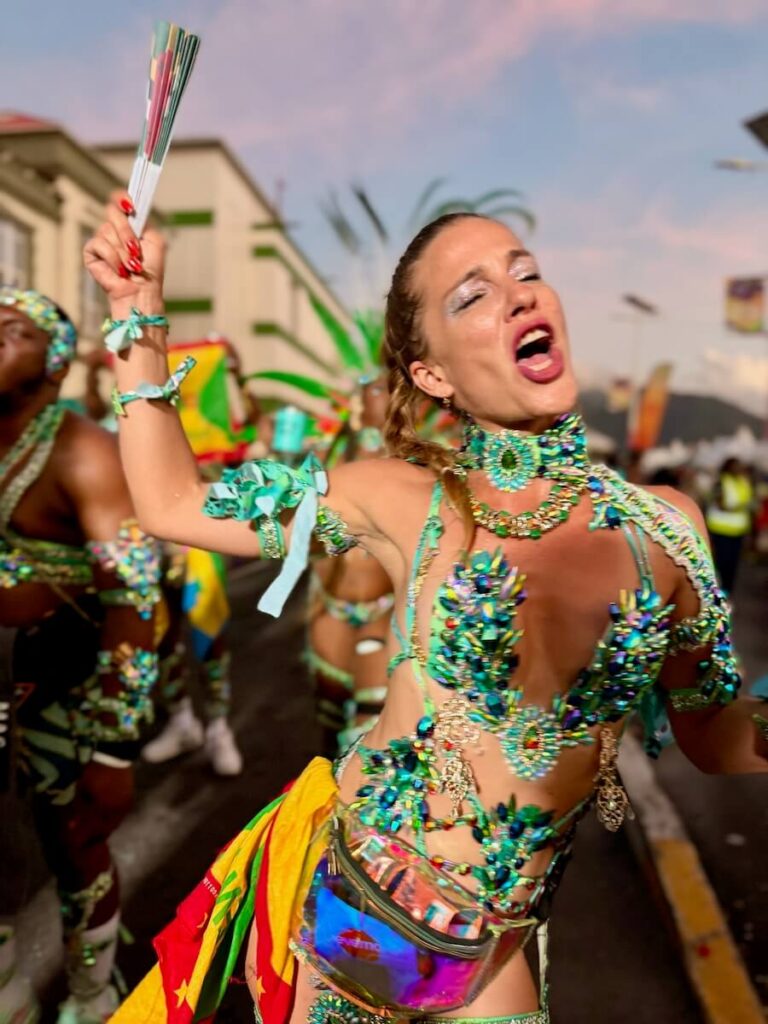
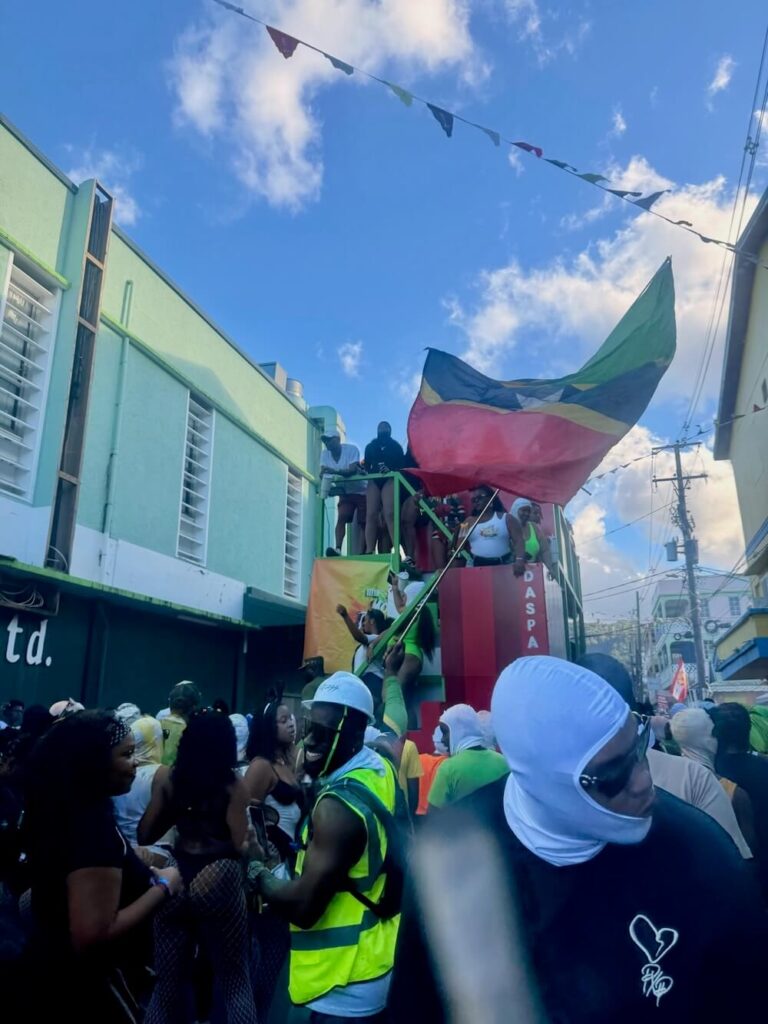
The capital becomes the Carnival route, meeting point and public stage. Carnival Monday brings J’ouvert, Youth Mas and T-shirt bands. Carnival Tuesday brings the grand parade, traditional masqueraders and contemporary costume bands.
This is when Roseau’s small scale becomes one of its biggest strengths.
Because the city is compact, you do not experience Carnival from a distance. You circle the capital. You pass the same buildings, the same corners and the same groups of people. You start to recognize the city through repetition: a balcony where people are watching, a vendor you have already seen, a turn in the road that suddenly feels familiar.
That repetition made Roseau come alive for me.
By the end of Carnival week, it felt as if we knew many of the people around us — not because we actually did, but because Carnival kept bringing the same faces back into view. Masqueraders, spectators, vendors, drivers, hotel staff, people at events, people on the road. Roseau became less anonymous each time we moved through it.
This is something larger capitals often cannot offer in the same way. In Roseau, Carnival feels close enough to become personal.
Practical Travel Tips for Roseau

Things to do in Dominica
Waterfalls, rainforest, hot springs and volcanic coastlines — Dominica is wild by nature.
-
Visiting Kalinago Barana Auté
Voices of Dominica’s First People Dominica is often described through its landscapes first. Rainforest. Rivers. Waterfalls. Hot springs. Volcanic peaks. Roads that twist through the mountains before opening suddenly to the Atlantic. It is an island that feels physical from the moment you arrive — green, humid, steep, alive. And yet, if you only come…
-
How to play mas in Dominica
Costumes, Culture and Mas There is a moment when Carnival stops being something you watch and becomes something you feel in your body. For me, that moment came on the road with Hysteria Mas in Dominica. The music was already moving ahead of us, the streets of Roseau were filling with people, and suddenly I…
-
Bouyon Music in Dominica: The Soundtrack of Mas Domnik
The Soundtrack of Mas Domnik Bouyon does not politely stay in the background. It pushes forward. It repeats. It builds pressure. It gets into your body before you have fully understood what you are hearing. During Mas Domnik, Dominica’s Carnival, bouyon is everywhere: on the road, at parties, during J’ouvert, from trucks, passing cars, street…
-
Soufrière and Southern Dominica: A Guide to the Island’s Volcanic Coast
Where the Island Turns Volcanic After the intensity of Mas Domnik in Roseau, southern Dominica felt like a different island. The capital had been all music, movement and Carnival rhythm. Bouyon in the streets. Costumes on the road. People watching from balconies. The same corners appearing again and again as we circled Roseau during Carnival….
-
Beaches in Dominica
Dominica’s Beaches, Without the Caribbean Filter Dominica is not the island I would recommend if your idea of the Caribbean is a week of white sand, beach loungers and polished resort beaches. And that is not criticism. Dominica is the Nature Island of the Caribbean for a reason. Its strongest landscapes are rainforest, rivers, waterfalls,…
-
Dominica Beyond Carnival: Best Things to Do Before or After Mas Domnik
Waterfalls, Rainforest and Culture Beyond Mas Domnik You may come to Dominica for Mas Domnik, but you should not leave having only seen Carnival. That was one of the biggest lessons of my trip. Mas Domnik gives you Dominica at full volume: bouyon on the road, J’ouvert in the early hours, T-shirt bands, pretty mas,…