Bahía de las Águilas Tour
At the Edge of Paradise
The southwest of the Dominican Republic is not the easiest part of the country to reach — and that is part of what makes it so memorable.
This is a region of long roads, dry forest, turquoise water, river pools, border towns and rocky coastline. The landscape changes constantly: mountains in the distance, the Caribbean Sea beside the road, cactus-covered cliffs, quiet villages and beaches that still feel shaped more by nature than by tourism.
Bahía de las Águilas is the destination many travellers come for, but the journey through the southwest is just as important as the beach itself. This part of the Dominican Republic offers a very different experience from the country’s better-known resort areas. It feels more remote, more layered and more connected to everyday local life.
At the same time, the southwest is not only beautiful. Close to the Haitian border, travel here also touches on migration, inequality, race, labour and human rights. That context matters. Visiting this region with awareness means allowing both things to be true at once: the landscapes are breathtaking, and the social realities are complex.
Because public transport is limited and some places require a suitable off-road vehicle, many travellers visit Bahía de las Águilas as part of an organised tour. A two-day tour from Santo Domingo is one of the easiest ways to experience the region without driving yourself.

Best places to stay in the Southwest Dominican Republic
In the southwest of the Dominican Republic, I would focus on smaller stays: guesthouses, lodges and simple hotels that make it easier to slow down, spend money locally and experience the region as more than a quick route to Bahía de las Águilas.
The landscape here feels raw, remote and specific, so the stay should feel connected to the place rather than separate from it. This is also a region where “eco” should be read with care. Some places use the word because they are close to nature, not necessarily because they follow transparent sustainability standards. Still, choosing smaller, locally rooted stays often fits the spirit of travelling the southwest best.
How to Visit Bahía de las Águilas Without Driving
A two-day tour to Bahía de las Águilas usually starts very early in Santo Domingo. The long distance makes an early departure necessary, especially if you want to include several coastal and river stops along the way.
Before departure, tour operators usually share the practical details by WhatsApp: meeting point, departure time, what to bring and the itinerary for the weekend. This makes the trip especially easy for solo travellers or anyone who does not want to organise transport, accommodation and boat access independently.
One practical note: included snacks and meals are often meat-based. Vegetarian and vegan travellers should bring their own snacks and ask about meal options in advance. Side dishes may be available, but choices can be limited.
From Santo Domingo, the city slowly disappears behind you, and the road begins to open towards the southwest.
Barahona: Gateway to the Dominican Republic’s Southwest Coast
Barahona is often seen as the gateway to the southwest.
Many tours stop briefly at the colourful town-name sign before continuing along the coast. It is a simple stop, but it marks the transition into a very different part of the country. From here, the route becomes increasingly scenic. The Caribbean Sea appears beside the road, the mountains rise in the background, and the landscape starts to feel more rugged and less polished.
This is also where the journey begins to feel like more than a transfer. Bahía de las Águilas may be the main reason many people come this far, but the route through Barahona, San Rafael, Los Patos and Pedernales gives the trip its depth.
San Rafael: River Pools, Sea Views and Local Life
San Rafael is one of the first natural swimming stops along the route.
Here, the Río San Rafael flows down towards the Caribbean Sea, forming small pools and cascades before reaching the beach. It is a lively, local place where people sit in the water, cool off, eat, talk and spend time together.
Small stalls and shops around the pools sell snacks and drinks, giving the stop an easy, social atmosphere. The landscape is beautiful: river water, stones, lush green surroundings and the open sea just beyond.
The sea itself can be rough here, so it is better to swim in the river pools rather than in the waves. San Rafael is less about a classic beach day and more about experiencing the way water, community and landscape come together along this coast.
Los Pocitos: A Natural Pool Beside the Caribbean Sea
Los Pocitos feels like a natural swimming pool beside the sea.
The water is clear, shallow in parts and calm enough for an easy swim. It is a popular local spot, with music, beach stalls, cold drinks and seating areas where people gather and relax. The atmosphere is casual and warm, with the kind of weekend energy that makes you want to stay longer than most tours allow.
The beach itself is rocky, but beautiful for a short walk and for taking in the coastline. The open sea can be rough here too, so the protected pools are the safest and most enjoyable place to swim.
Nearby, SeaBreeze Hotel is worth noting for travellers who want to stay longer in the area, especially for its terraces facing the sea.
Los Patos: Lunch, River Water and a Colourful Coastal Stop
Los Patos is another place where river water meets the Caribbean.
It is colourful, lively and easy to enjoy without needing to do much. People walk through the shallow water, sit by the shore, take photos, eat, drink and enjoy the view. It feels like a place made for lingering.
Many tours stop here for lunch, often at D’Luis Restaurant. Expect simple, generous Dominican food such as grilled fish, chicken and typical sides like tostones. After hours on the road, it is exactly the kind of meal that fits the journey: fresh, filling and local.
What makes Los Patos memorable is the combination of food, water, colour and movement. It is not a polished attraction, and that is part of its charm. It gives the route a sense of everyday.
The Haitian-Dominican Border Near Pedernales
A stop near the Haitian-Dominican border changes the tone of the journey.
Until this point, the route is mainly shaped by river pools, music, coastal views and local beach stops. At the border, the reality of Hispaniola as one island shared by two countries becomes much more visible.
The relationship between the Dominican Republic and Haiti is complex. It is shaped by colonial history, race, language, migration, labour, poverty, political instability and decades of mistrust. It cannot be properly explained in one short travel section, and it should never be reduced to a quick stop on an itinerary. But travellers visiting this region should be aware of it.
Haiti is currently facing a severe humanitarian and security crisis, while human rights organisations have repeatedly criticised the Dominican Republic for its treatment of Haitian migrants and Dominicans of Haitian descent, including discrimination, deportations and violations of migrants’ rights.
This context matters when visiting the border region. It is not just a place to take a photo or buy a cold drink. It is a place where politics, migration, inequality and everyday survival meet.
There is a binational market at the border, usually open on selected market days, where Haitian and Dominican vendors sell fruit, vegetables, clothing, souvenirs and other goods. If your itinerary allows, visiting on a market day can be a way to support vendors directly.
If you visit the border market, go with sensitivity. Buy from local vendors where you can, but do not treat the market or the people there as a photo opportunity. Avoid photographing people, especially Haitian vendors and migrants, unless someone clearly invites it. In this context, consent matters deeply.
Overnight in Pedernales: A Quiet Base for Bahía de las Águilas
Pedernales is the natural base for visiting Bahía de las Águilas.
The town feels quiet and far removed from the Dominican Republic many travellers imagine first. It is small, practical and still relatively low-key, though the wider region is changing as tourism development grows around Cabo Rojo and the southwest.
After a long day on the road, most tours spend the night in or near Pedernales. Depending on the tour, the evening may include dinner and a small group event. The atmosphere is usually relaxed and social, but the main reason to stay here is simple: it puts you within reach of Bahía de las Águilas the next morning.
Bahía de las Águilas: The Wild Beach That Defines the Southwest
Bahía de las Águilas is the place many travellers picture when they think of the Dominican Republic’s southwest.
Located inside Jaragua National Park, it is an eight-kilometre stretch of white sand and clear turquoise water. There are no hotels, restaurants or shops directly on the beach, which is one of the reasons it feels so special.
This is not a beach built around visitors. It still feels as if the landscape comes first.
The setting is striking in its simplicity: white sand, transparent water, cliffs, sky and an unusual sense of space. There are no hotel rows behind you, no beach clubs, no loud commercial strip. Just the sea and the scale of the coast.
At the same time, Bahía de las Águilas should not be reduced to the idea of “untouched paradise.” The wider Cabo Rojo and Pedernales area is undergoing major tourism development, including resort, airport and cruise infrastructure. That makes the experience feel both beautiful and bittersweet. You are visiting one of the most remarkable coastal landscapes in the Caribbean at a time when the region’s future is being actively shaped.
Boat Trip from Cabo Rojo to Bahía de las Águilas
The boat ride from Cabo Rojo is one of the most beautiful parts of visiting Bahía de las Águilas.
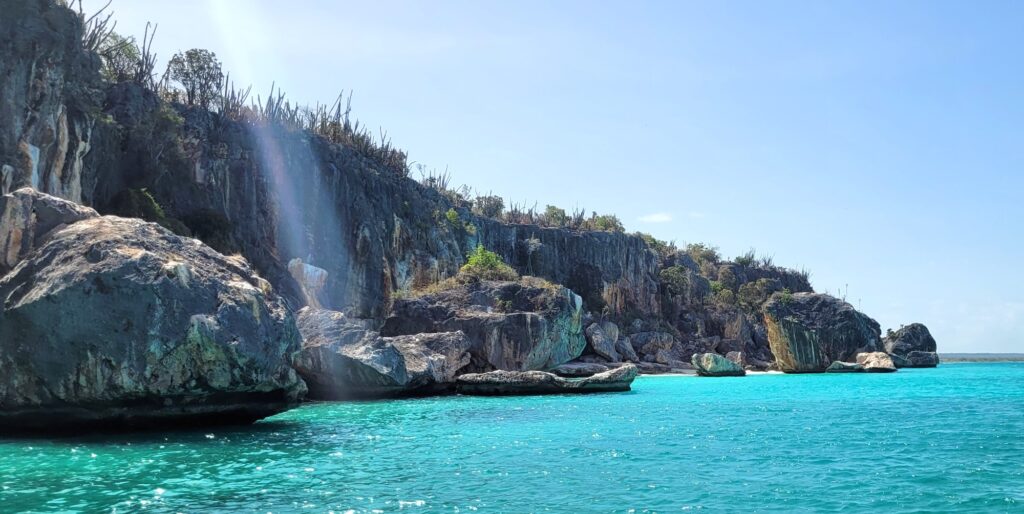
Small boats take visitors along the coast, passing rugged limestone and coral rock formations, pale cliffs in shades of grey and yellow, cacti, palms and clear water that shifts from turquoise to deep blue.
The route feels cinematic, but not polished. The landscape is dry, bright, sharp-edged and full of contrast. It gives the arrival at Bahía de las Águilas more weight, because you do not simply appear at the beach — you approach it slowly by sea.
When the boat reaches the bay, the colours are almost unreal. The sand is bright white, the water is transparent, and the blues seem to stretch endlessly across the shoreline.
Most tours allow around two hours on the beach. That is enough time to swim, walk, take photos and absorb the place, though slow travellers may wish they had longer.
Responsible Travel at Bahía de las Águilas: Why Plastic Matters
Bahía de las Águilas is beautiful, but it is also fragile.
Plastic waste is one of the most visible issues. Even when tour guides provide rubbish bags, light plastic cups, bags and straws can easily end up on the sand or in the water, especially when the wind picks up.
In a protected area, this matters. Bahía de las Águilas is not just a scenic beach. It is part of a wider ecosystem, and the region is important for wildlife, including sea turtles.
Visitors can make simple but important choices: bring a reusable cup or bottle, avoid straws, keep hold of rubbish, and pick up anything that is blowing towards the water if possible.
Places like this do not stay beautiful by accident. They stay protected when visitors, guides and local operators treat them as fragile landscapes rather than disposable backdrops.
Sancocho and the Road Back
After leaving Bahía de las Águilas, tours usually return by boat to Cabo Rojo before continuing to lunch.
A common meal on the route is sancocho dominicano, a traditional Dominican stew made with meat, vegetables, plantains and herbs, often served with rice. It is rich, warm and filling, especially after a morning in the sun.
Vegetarian and vegan travellers should ask ahead, as sancocho is usually meat-based and alternatives may be limited.
Arroyo Salado: A Final Swim Among Mangroves
Arroyo Salado is often one of the final stops before the long journey back.
The pools here are clear, slightly salty and surrounded by mangroves and thick vegetation. After the dry landscapes around Cabo Rojo and Bahía de las Águilas, the colours feel completely different: green, turquoise, shaded and cool.
It is a refreshing place for a last swim, and the atmosphere is calmer than some of the busier coastal stops. If you walk around the corner to the right, you can usually find a smaller pool that feels quieter.
As a final stop, Arroyo Salado works well because it shows another side of the southwest: not just beaches and cliffs, but mangroves, fresh water, shade and dense vegetation.
More Places to Visit Near Bahía de las Águilas
If you have more time in the southwest, it is worth extending the trip beyond Bahía de las Águilas.
Laguna de Oviedo is one of the most interesting additions. The saltwater lagoon lies inside Jaragua National Park and is known for birds, mangroves and a very different kind of landscape.
Another beautiful stop is the sandbank beside the Río Nizaito leading towards Playa Paraíso, which offers a quieter coastal experience and a good option for a longer walk.
The southwest is not a region to rush if your itinerary allows more time. It is one of the Dominican Republic’s most powerful landscapes: beautiful, complex, fragile and still very different from the country’s more developed tourism areas.
That is exactly why it deserves to be visited with care.
Practical Travel Tips for Dominican Republic

More things to discover around Santo Domingo
Places to visit in the Caribbean
-
Can All-Inclusive Resorts Be Ethical? A Traveler’s Checklist
Can All-Inclusive Resorts Be Ethical? A Traveler’s Checklist I am not naturally an all-inclusive traveler. I like the slightly messy parts of travel: finding a roadside restaurant because someone mentioned it in passing, taking a ferry, waiting too long for a bus, speaking to a driver, walking through a market, staying in a small guesthouse…
-
Sustainable Travel | Caribbean | Jamaica | Lebanon | Middle East | St. Lucia | St. Vincent and the Grenadines
When Is It Okay to Travel After a Catastrophe?
When Is It Okay to Travel After a Catastrophe? There are moments when a trip stops being just a trip. A flight is booked. A hotel is confirmed. You have an itinerary. Then something happens: a hurricane, an earthquake, a flood, an explosion, an attack, unrest. Suddenly, the question is no longer only: Can I…
-
Carriacou Travel Guide 2026: A Quiet Caribbean Island Rebuilding Beautifully
The Quiet Power of Carriacou Carriacou is Grenada’s quieter sister island — small, sea-shaped, culturally rich and deeply welcoming. It is known for beaches, sailing, diving, traditional boatbuilding, Big Drum, Shakespeare Mas and a slower way of life that feels increasingly rare in the Caribbean. Grenada’s second-largest island spans about 13 square miles, with Paradise…
-
Plantation Beach Villas Tobago: A Beachfront Home in Black Rock
Paradise on the Edge in Portland There are places you stay because they are practical, and there are places that quietly become part of the trip itself. Plantation Beach Villas falls into the second category. Set directly on Great Courland Bay in Black Rock, the villas offer the kind of space and independence that can…
-
Tourism Leakage: Why Your Vacation Money Does Not Always Stay Where You Travel
Tourism Leakage: Why Your Vacation Money Does Not Always Stay Where You Travel Tourism leakage asks us to look beyond the beautiful surface of travel. Beyond the beach, the hotel, the tour, the perfect breakfast view. It asks a less comfortable question: when I spend money here, does it help build local value — or…
-
When Culture Becomes Content: Are We Witnessing or Consuming?
When Culture Becomes Content: Are We Witnessing or Consuming? Travel teaches us to look closely. Social media teaches us to share quickly. Somewhere between the two, culture can become content before we have taken the time to understand it. I struggle with this more than people might think. As a travel writer, I am drawn…